
Cyberdise AG

The Zeitenwende of Attack Vectors

Published Date:

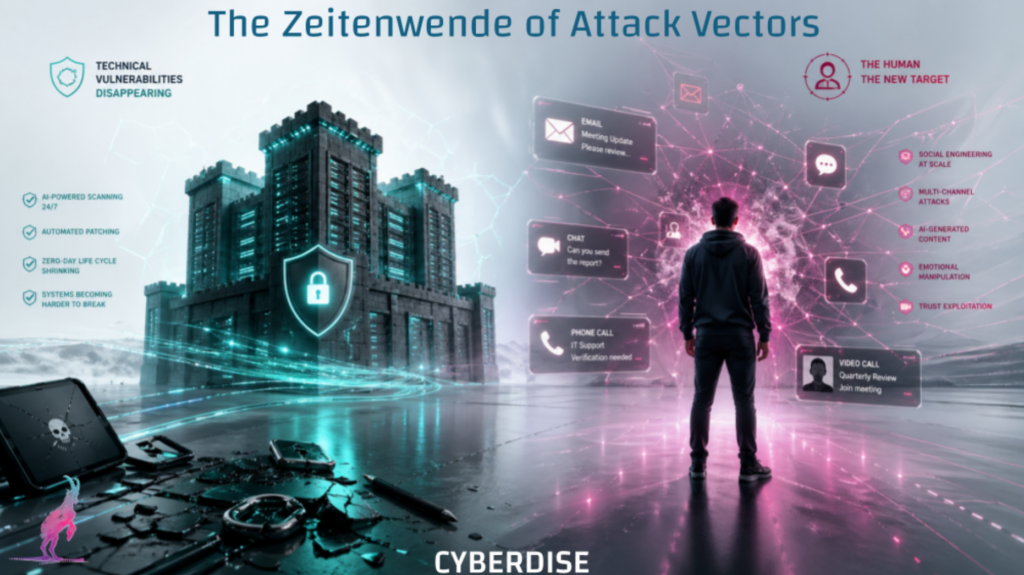
Concept banner titled "The Zeitenwende of Attack Vectors." On the left, in teal, a fortress built from data-center server racks stands behind a glowing padlock shield — hardened technology with disappearing vulnerabilities — while shattered smartphones lie in the foreground. On the right, in pink, a lone hooded figure seen from behind is surrounded by fake email, chat, phone, and video-call messages, labeled "The human – the new target."

What happens when technical vulnerabilities disappear in the future – and humans become the primary target? An overview.

  1. The End of the Classic Playing Field
  2. When Exploits Lose Their Value
  3. The Human as the Last Point of Attack
  4. The New Quality of Attacks
  5. The Quiet Shift Inside Companies
  6. The Zeitenwende

There’s a lot of talk right now about AI becoming the better hacker – see also <here>. What often gets overlooked: that’s only the first phase. A proverbial cybercrime Zeitenwende begins after that.

The End of the Classic Playing Field

Over the past decades, cyberattacks were relatively clearly structured:

  • Find a vulnerability, develop an exploit, gain access, and so on (just Google “Cyber Kill Chain”).
  • The “bottleneck” was always the technical gaps. Vulnerabilities, let alone 0-days, were rare, expensive, and highly profitable. With AI, exactly that is changing.
  • As of today, systems like the models demonstrated by Anthropic are able to find vulnerabilities faster, analyze them more systematically, and – looking ahead – also validate and patch them automatically!

This means the half-life of 0-days drops drastically, because from now on they get discovered and closed quickly.

When Exploits Lose Their Value

This leads to an economic shift that’s hardly being discussed. Attackers don’t optimize for elegance – they optimize for return. And this is exactly where the system tips over:

  • 0-day exploits used to be relatively rare, expensive, and long-lived. From now on they’ll be discovered more often and patched faster.
  • Technical attacks used to deliver a high ROI. From now on, that ROI will decline.
  • Social engineering used to be limited in scalability and often clumsy. From now on it becomes clever and massively scalable thanks to AI.

Capital and energy will migrate to wherever attacks are still worthwhile – that’s the logical consequence.

The Human as the Last Truly Profitable Point of Attack

And here comes the uncomfortable truth: when systems get harder, only one real vulnerability remains – the human. Yes, of course, that’s not a new insight, but what is new is the dynamic we can expect!

The data already shows a clear trend today:

  • The majority of all attacks begin with social engineering
  • AI-generated phishing campaigns scale massively
  • Attacks are becoming personalized, multi-stage, and cross-channel

You can reach for all kinds of sources. The study “Cybersecurity & Digital Resilience 2026” [1] that we recently analyzed puts it in a nutshell:

  • Every relevant attack vector starts with social engineering
  • At the same time, only 43.5% of organizations have implemented mandatory training
  • 56% still rely on classic awareness-training approaches whose impact is limited. Btw: we’ve proven that weak effectiveness here [2], along with the approaches that really do work well.

This means the human attack surface stays wide open, while technical security will increase considerably.

The New Quality of Attacks

What’s changing in parallel is the nature of the attacks. We’re moving away from simple phishing emails toward:

  • Time-orchestrated campaigns
  • Personalized content based on real data in the recipient’s context
  • Deepfake-assisted interactions
  • Multichannel attacks (today a vish, tomorrow an SMS, then the email)

The crucial point here is that these attacks are no longer manual! They’re automated and therefore scalable. Naturally, they’re also data-driven and continuously optimized by the criminals. In short: AI industrializes social engineering.

The Quiet Shift Inside Companies

While the bad guys’ attack vectors are changing, internally the opposite often happens on our side. The focus stays on technology – that is, infrastructure, compliance, tools.

The report mentioned above, “Cybersecurity & Digital Resilience 2026,” shows it clearly:

  • Security budgets keep rising
  • but investments flow primarily into technical measures

At the same time, the human stays under-addressed. That’s a structural problem we know all too well.

The Zeitenwende of Attack Vectors

The real Zeitenwende, therefore, isn’t technological, it’s strategic. What do I mean by that? Well, cybersecurity has long been a question of:

  • “How do we protect our systems?” (Today)

It’s increasingly becoming:

  • “How do we change human behavior under attack?”

The reality is: systems are getting more robust, attacks are getting more intelligent, and humans remain consistently manipulable. The playing field is starting to shift – permanently!

Conclusion

We’re moving toward a new reality in which:

  • 0-days become rarer and shorter-lived
  • technical attacks lose their appeal
  • social engineering becomes the dominant attack vector

Not because it’s new, but because it’s almost the only thing cybercriminals have left. The biggest challenge of the next decade isn’t a system – it’s human behavior.

And that’s exactly where cybersecurity will be decided going forward: in strengthening behavioral defenses. Others improve employees’ knowledge – but CYBERDISE changes their behavior!

Does anyone see it differently? I’m curious to hear a comment or two 🙂

So long, Palo

Enjoyed reading? Subscribe to our blog!