When the Dark Side of “Multipliers” Comes into Play: Impact on Cybersecurity
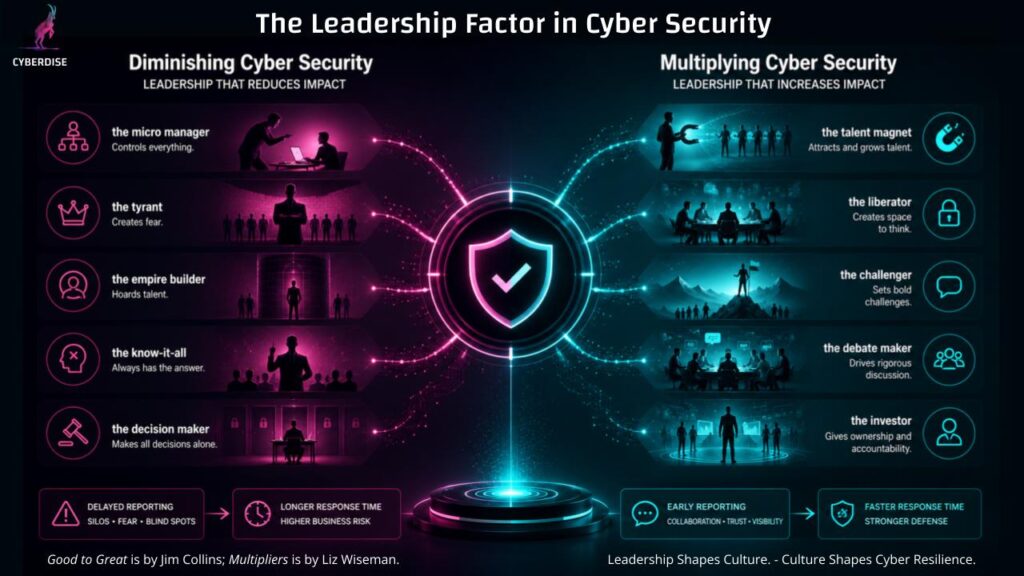
The best way to derive the impact on a company’s cybersecurity is to look closely at the individual leadership types. For the diminishing types, these are:
- The Empire Builder – Hoards talent.
- The Tyrant – Creates fear.
- The Know-It-All – Always has the answer.
- The Decision Maker – Makes all decisions alone.
- The Micro-Manager – Controls everything.
Cybersecurity Impacts with The Tyrant
With the Tyrant, it’s glaringly obvious. Fear dominates their department, mistakes are not tolerated, and free thinking is stifled right from the start. Employees either strictly work to rule or are so intimidated that they mentally freeze.
When a cyberattack hits – like a suspicious phishing email or an unusual system state – common sense no longer plays a role. Out of fear of penalties or making mistakes, the incident is hidden away rather than being reported immediately to the security team. This drastically extends the attackers’ reaction window.
Cybersecurity Impacts with The Know-It-All
The Know-It-All believes they understand every danger and every solution entirely on their own. For information security, this type is fatal because they often view security policies as “rules for everyone else” or bypass official security guidelines by introducing their own IT shadow solutions.
Under them, the team unlearns how to independently question risks and think ahead. If an employee discovers a potential vulnerability, they keep it to themselves – after all, the boss knows better anyway. This creates a dangerous corporate blindness to real-world threats.
Cybersecurity Impacts with The Empire Builder
The Empire Builder accumulates resources and talent to demonstrate power and prestige within the company, but fails to actually develop or challenge them. For cybersecurity, this means security experts or IT managers are isolated in silos instead of collaborating across departments.
Critical security information and log data are hoarded as proprietary knowledge instead of being shared transparently within the company. When a security incident occurs, fast and direct communication channels are missing because silo-thinking completely paralyzes the incident response.
Cybersecurity Impacts with The Decision Maker
Okay, I can’t imagine this happening in IT security departments, but let’s think it through anyway: The Decision Maker makes all security-relevant or strategic decisions in a quiet room upstairs. They do this completely without utilizing SOC systems, ratings, or listening to actual IT security subject matter experts.
The consequence is a massive lack of buy-in and understanding within the team. Security systems and policies are not supported by the workforce because they are impractical and were dictated over their heads. Since nobody understands the reasoning behind them, bypass attempts (shadow IT) skyrocket in daily operations, opening up brand new entry points for attackers.
Cybersecurity Impacts with The Micro-Manager
The Micro-Manager controls every single click, every report, and every trivial task of their employees. By doing so, they strip the team of all self-reliance and initiative.
In the context of cybersecurity, this leads to absolute paralysis during cyber incidents. When seconds matter to contain a ransomware attack, employees prefer to wait for explicit approval from the micro-manager before disconnecting an infected device from the network. This delay gives attackers the exact time they need to encrypt the entire corporate network. – And gotcha!
Cybersecurity Impacts with the Positive Leadership Types in Multipliers
Now, let’s turn to the positive Multiplier types and their impact on cybersecurity:
- The Talent Magnet – He attracts top security talent and lets them shine. Because his people – and not just the cybersecurity experts – can achieve real impact under his leadership, they stay with the company. This solves the IT security talent shortage and ensures a stable, well-coordinated defense team with plenty of experience.
- The Liberator – He creates a fearless culture of psychological safety. If an employee clicks a phishing link, they report the mistake immediately and without shame. This extremely short reaction window contains the danger, perhaps even before damage is done.
- The Challenger – He rarely dictates solutions but asks smart questions instead. This drives his team to continuously and critically question existing security concepts and systems, rather than blindly relying on outdated guidelines.
- The Debate Maker – He ensures that security risks and IT projects are debated fiercely on the merits within the team. Because all subject matter experts are heard, practical security guidelines emerge that are understood and genuinely supported by the entire workforce in everyday operations.
- The Investor – He transfers full accountability to the employees. As a result, responsibility for security lies directly with the staff and the security team. In an emergency, the team doesn’t wait for permission; they act independently during a cyberattack and stop the spread of malware in seconds.
Good Leadership and Culture Make Cybersecurity Better and Employees Happier (and Safer)!
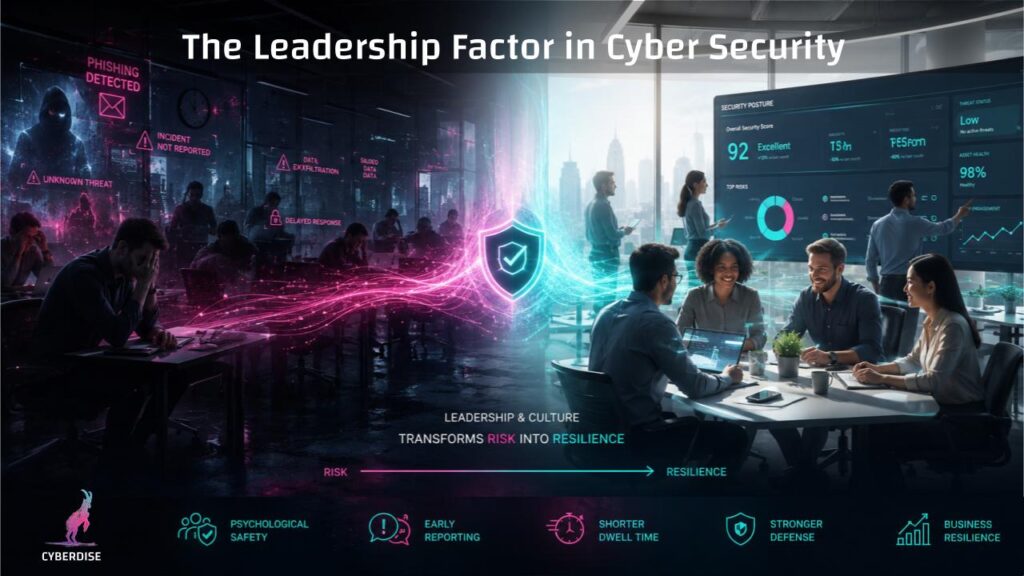
It is obvious: When good leadership is practiced in a company – whether it’s Collins’ Good to Great, Wiseman’s Multipliers, or based on any other solid leadership concept – it will have a clearly positive impact on security across the enterprise! And let’s be honest: Most of the time, it’s just much more fun to work in organizations like that, isn’t it?
Good leadership creates the psychological foundation – but how do you operationalize this secure behavior in daily business? This is exactly where we step in at CYBERDISE with our concept of Behavioral Defense Engineering (BDE). BDE breaks away from rigid theory training and leverages the agile mindset of Multiplier teams: The real, and in the age of AI, psychologically optimized attacks from criminals are converted by our product into real-time simulations. This is how we train secure behavioral habits directly within the stressful workday.
When leaders establish a culture free of fear and technology translates human reactions into active defense data, the workforce transforms from a theoretical risk into the company’s strongest line of defense. That’s what BDE can do!
So Long, Palo Stacho
#humanauthored