
How to Create a ClickFix Simulation with Cyberdise Behavioral Defense Engineering
Published Date:
- July 8, 2026
Cybercriminals have become remarkably good at bypassing technical security controls. Rather than exploiting software vulnerabilities, many modern attacks exploit something much easier: human behavior.
One of the fastest-growing examples is ClickFix. Instead of asking users to click a malicious attachment, attackers guide them through what appears to be a legitimate troubleshooting or verification process. The victim ultimately executes the malicious action themselves.
For security awareness teams, this represents an important shift. Traditional phishing exercises are still valuable, but they no longer cover the full spectrum of modern social engineering. Organizations increasingly need a ClickFix simulation that prepares employees for these interaction-driven attacks before they encounter them in production. This article shows how to create one in Cyberdise Awareness — from scenario selection to delivery and measurement.
What is ClickFix?
ClickFix is a social engineering technique in which attackers convince users to perform technical actions that ultimately compromise their own systems. Unlike traditional phishing, the attack usually doesn’t rely on a malicious attachment or exploit. Instead, users are presented with what appears to be a legitimate verification step.
Typical instructions include: “Verify you’re human”, “Repair your Microsoft 365 document”, “Update your SAP security component”, “Fix your browser security module”.
The instructions appear routine and often resemble the kind of technical guidance users have seen before. Victims are typically asked to:
- press Win + R
- paste a command
- execute PowerShell
- run a verification command
- install a “required” component
Once executed, malware, credential stealers or remote access tools are downloaded and installed.
The important observation is that the user performs the critical action voluntarily. From the operating system’s perspective, nothing suspicious happened—the user simply followed instructions.
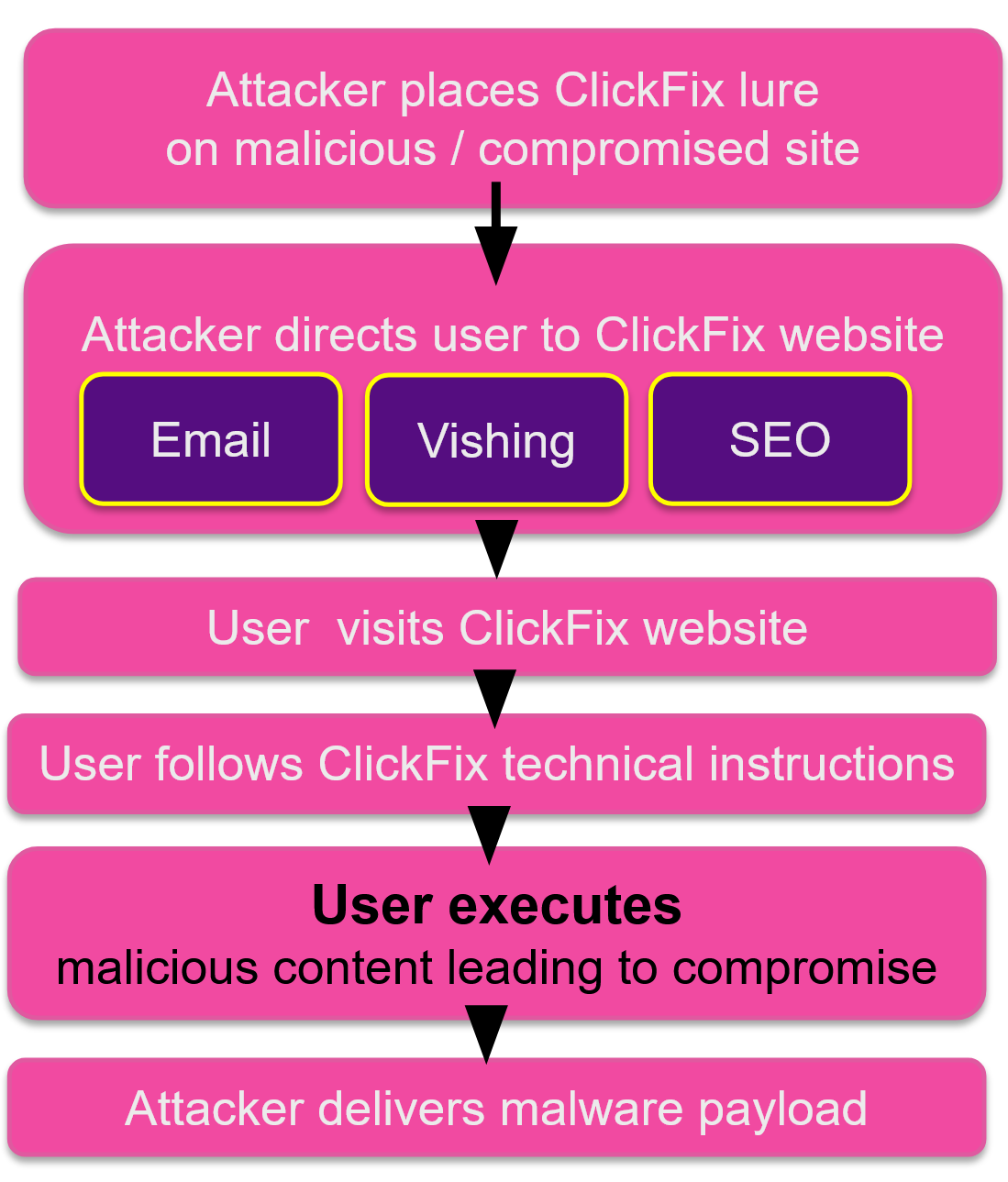
A typical ClickFix workflow looks like this: attackers lure users to a fake website through email, vishing, SEO poisoning or other channels. The website displays convincing technical instructions, the user follows them, executes the supplied command, and malware is delivered to the endpoint.
Social Engineering Continues to Evolve
Modern social engineering no longer consists solely of phishing emails. Attackers increasingly combine multiple channels, including email, voice calls, messaging applications, malicious advertisements and compromised websites. At the same time, they have shifted from simple link-clicking attacks to interaction-driven attacks (like ClickFix) that require the victim to actively perform technical actions.
According to the 2026 Check Point Cyber Security Report [1], ClickFix emerged as one of the most significant initial access techniques during 2025. The report describes a roughly 500% increase in ClickFix activity compared to the previous year, with the technique appearing in nearly half of documented malware campaigns. It also highlights the emergence of related techniques such as FileFix and ConsentFix, illustrating how quickly successful social engineering concepts evolve.
This development reinforces an important point:
Security awareness today is no longer just about recognizing suspicious emails. Employees increasingly need to recognize suspicious processes and workflows.
Why ClickFix Simulations Matter
Most employees already know they should avoid clicking suspicious links.
ClickFix tries to bypass this knowledge. Instead of asking users to trust a suspicious email, attackers ask them to trust what appears to be a legitimate IT support workflow.
The victim believes they are:
- fixing Microsoft Office
- repairing a browser issue
- updating SAP
- restoring a VPN session
- opening a protected document
The attacker simply embeds malicious instructions inside a believable business process.
This is precisely why a ClickFix simulation is becoming an important addition to traditional phishing simulations. It helps organizations evaluate whether employees recognize suspicious technical instructions—not merely suspicious emails.
Common ClickFix Scenarios
Although the classic fake CAPTCHA remains common, attackers increasingly target enterprise applications that employees use every day. Some examples include:
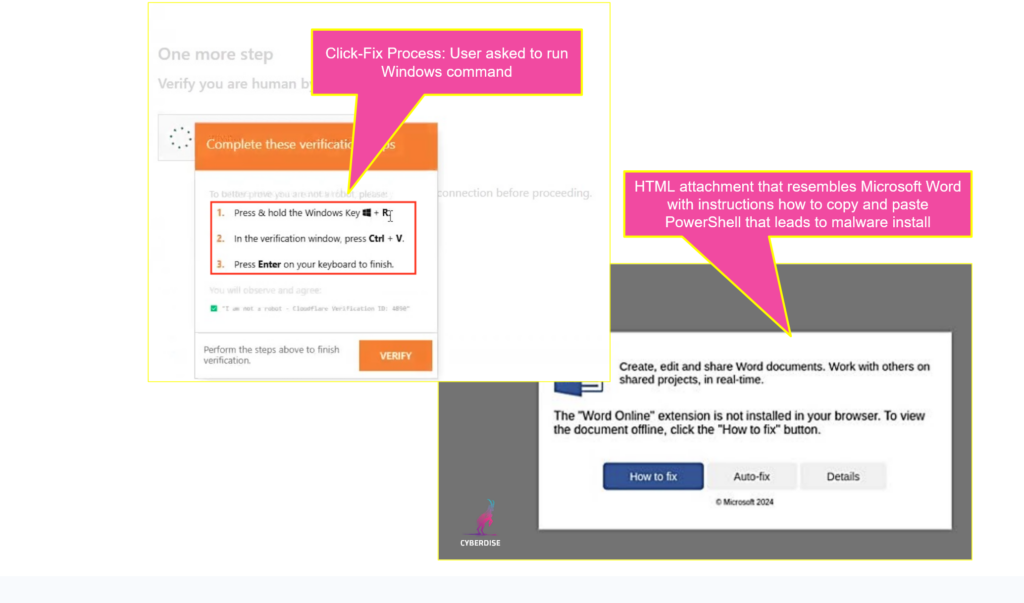
- Fake CAPTCHA – “Verify you’re human.” The user is instructed to execute a malicious PowerShell command.
- Microsoft 365 Document Repair – “This document cannot be rendered securely.” Running the suggested repair command installs a credential stealer or remote access trojan (RAT).
- SAP Secure Login – “Your security component is outdated.” A fake verification command executes malware before the SAP session starts.
- Salesforce Session Verification – “Refresh your browser security module.” The attacker steals session cookies or authentication tokens.
- Oracle HCM / Workday – “Run validation before opening payroll.” An infostealer harvests corporate credentials.
- Microsoft Teams / Zoom – “Audio codec verification failed.” The fake fix results in malware installation.
- VPN Portal – “Certificate validation failed.” The user is tricked into compromising their endpoint.
- Citrix Workspace – “Security plugin needs verification.” The attack installs remote access malware.
- SharePoint – “Protected document viewer requires activation.” The fake activation process leads to credential theft.
- Microsoft Entra ID – “Device registration requires local verification.” The attacker compromises the user’s cloud account.
Creating a ClickFix Simulation in Cyberdise Awareness
Cyberdise Awareness allows organizations to create realistic ClickFix simulations that reflect their own environment and business applications. The process is straightforward.
1. Create a ClickFix simulation campaign
Create a phishing simulation as you normally would and select the target recipient group
2. Choose a realistic ClickFix scenario for your company
Select a ClickFix scenario that resembles a workflow your employees actually encounter. The more closely the exercise reflects everyday work, the more meaningful the behavioral observations become.
3. Build the landing page for the ClickFix simulation
Using the Cyberdise Website Cloner, existing web pages can quickly be transformed into realistic landing pages for your ClickFix simulation that closely resemble legitimate business portals. The cloned content can then be customized for the exercise.
4. Select your delivery method
Cyberdise supports both delivery approaches commonly observed in real-world ClickFix campaigns.
Option 1 – URL Delivery
The email or the landing page behind it contains ‘only’ a link. Users are directed to the simulation landing page (index.html), where the ClickFix dialogue is displayed.
To measure successful interaction, the copied command has to be implemented as a hyperlink inside the landing page (pointing to account.html). When users click Copy, they are redirected to the success page (= account.html), allowing the ClickFix simulation to record successful completion.
This closely reflects many current ClickFix attacks, where the malicious workflow is hosted entirely on an external website.
Option 2 – HTML Attachment Delivery
Alternatively, the phishing email can contain an HTML attachment instead of linking to an external website (Knowledge Base).
When opened, the HTML file renders the fake ClickFix page locally in the user’s browser. Cyberdise supports creating these HTML-based exercises using its File Based Attachment functionality. This approach mirrors real-world campaigns in which the landing page itself is delivered as an HTML attachment rather than through a URL.
An additional advantage is that downloading or opening the HTML attachment provides a clearly measurable success event during the exercise.
Behavioral Defense Engineering in Practice
ClickFix demonstrates how quickly social engineering techniques evolve.
Employees are no longer simply asked to click links—they are increasingly persuaded to execute technical procedures that appear completely legitimate.
Preparing users for these attacks requires more than conventional phishing simulations.
Behavioral Defense Engineering focuses on improving defensive behavior by exposing employees to realistic attack workflows before they encounter them in production. ClickFix exercises complement traditional phishing campaigns by helping employees recognize manipulation embedded within everyday business processes rather than just suspicious emails.
Conclusion
Organizations that continue to rely solely on traditional and standardized phishing simulations risk leaving an important attack vector unaddressed.
By incorporating realistic and customized ClickFix simulations into your security awareness program, organizations can better prepare employees for interaction-driven attacks that increasingly resemble legitimate business workflows.
As attackers continue to innovate, defensive behavior must evolve just as quickly.
FAQ
What is a ClickFix simulation?
A ClickFix simulation is a simulated version of a ClickFix attack used in security awareness training. It presents employees with a fake but realistic technical prompt (for example, a “document repair” or “verification” step) and measures whether they follow the instructions — such as pasting and running a command — without triggering any real compromise.
How is a ClickFix simulation different from a standard phishing simulation?
A standard phishing simulation typically tests whether a user clicks a malicious link or opens an attachment. A ClickFix simulation instead tests whether a user will actively execute a technical action — such as opening the Windows Run dialog and pasting a command — after being guided through what looks like a legitimate troubleshooting or verification workflow.
What makes ClickFix attacks hard to detect technically?
Because the user manually opens the dialog and executes the command themselves, the operating system sees the action as an intentional, user-initiated task rather than an external exploit or malicious attachment. This lets ClickFix bypass many controls that focus on detecting malicious links, attachments or automated exploitation.
Common lures mimic everyday business workflows employees already trust, such as a Microsoft 365 “document cannot be rendered” prompt, an SAP or VPN “security component” update, a Salesforce or Teams “verification” step, or a generic “Verify you’re human” CAPTCHA-style check.
How do you create a ClickFix landing page for a simulation?
In Cyberdise Awareness, teams can use the Website Cloner to transform an existing, familiar web page into a realistic ClickFix landing page, then customize the fake verification or repair instructions and command before delivering it via a URL or an HTML attachment.
Can ClickFix simulations be delivered as an HTML attachment instead of a link?
Yes. Cyberdise supports both URL-based delivery, where the landing page is hosted externally, and File Based Attachment delivery, where the ClickFix page is rendered locally when the employee opens an HTML file — mirroring both delivery patterns seen in real-world ClickFix campaigns.