
Cyberdise AG

The Near Future of AI: Local Models, Digital Twins, and the End of Cheap Intelligence

Published Date:

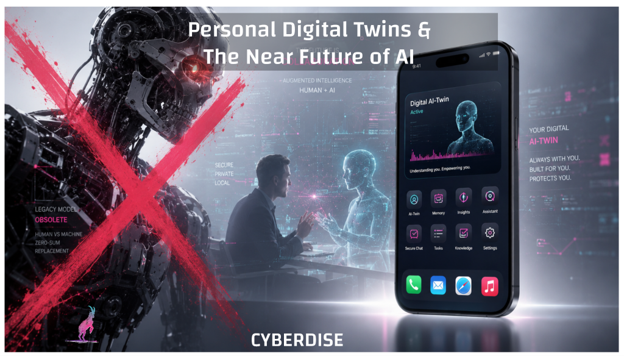
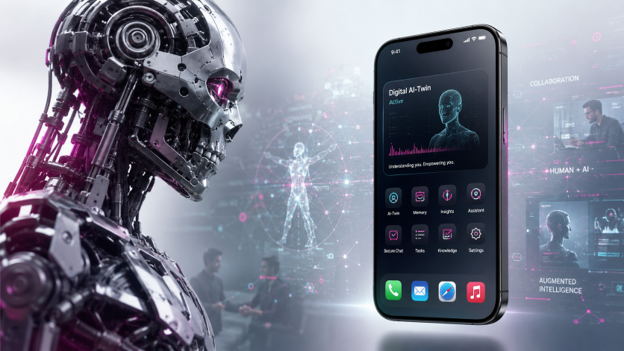
Intro Image of the article

“Software is eating the world” is a well-known saying, and the prediction is clearly playing out. Today, though, it’s no longer primarily software that’s reshaping our economy and society — it’s artificial intelligence itself.

The Bottleneck Most People Don’t  See: Electricity

Demand for AI computing power is exploding. Data centers’ share of U.S. electricity consumption has climbed from roughly 4% to about 8% in just a few years. At the same time, the major generative AI providers continue to post massive losses. Even premium subscriptions like ChatGPT Pro at $200 a month appear to barely cover the actual infrastructure and energy costs.

That puts us in an unusual position: demand for AI is growing exponentially, while available power and compute capacity simply can’t expand at the same pace. New power plants, grids, and data centers don’t appear overnight.


Why AI Could Get Significantly More Expensive Soon:

This trajectory will inevitably have economic consequences. When a resource becomes scarce, its price goes up.

I expect we’ll see substantial price increases across many AI services in the near future. AI is going to get more expensive. Companies with deep enough budgets will keep their access to the most capable models. Smaller businesses and individuals will either pay more or have to make do with more limited resources.

The era of near-unlimited, cheap AI may end sooner than most people expect.


The Return of AI to the Device

This is exactly where a possible escape route opens up.

Not every use case needs a massive language model that can explain complex philosophical concepts or analyze scientific papers. Most everyday tasks can be handled by far smaller models.

That’s why I expect a major shift toward local AI on end devices over the next two years. Smartphones, laptops, and workstations will increasingly run their own AI models, falling back on powerful cloud models only when a task genuinely requires it.

This shift brings not just economic benefits but significant privacy ones too.

To me at least, it sounds far more appealing to have banking data, health information, or legal documents processed by a locally installed AI agent rather than shipped off to ChatGPT, Gemini, Claude, or other cloud services

From Assistant to Digital Twin

The most interesting consequence of this shift is something else entirely.

If every person permanently carries a personal AI assistant on their device, that assistant will learn more and more about its owner over the years. It’ll know their communication style, preferences, habits, decisions, and areas of expertise.

I believe these assistants will gradually evolve into digital twins.

The fusion of human and digital identity isn’t science fiction to me — it’s the logical next step of where the technology is already heading.

The birth of the cyborg may be closer than most people think.

That may be exactly why Mark Zuckerberg is publicly talking about building digital AI versions of people. The direction of travel is already clear.

Why Apple, Tesla, and Google Get Particularly Interesting

For this reason, I’d keep an especially close eye on Apple and Tesla in the coming years — and on Google in any case.

While many AI companies are primarily software or cloud providers, Google, Apple, and Tesla have something different: direct control over hardware that goes well beyond the CPU and NPU.

If the future really does move toward local AI and personal digital assistants, the companies that benefit most will be the ones that can deliver hardware and software from a single source.

The decisive platform of the future may not be the data center, but the device in our pocket, on our desk, or in our vehicle.

What Does This Mean for Cybersecurity?

As a cybersecurity entrepreneur, I naturally look at this through another lens.

If personal AI assistants really do evolve into digital twins, we get a fundamentally new reality: the line between the flesh-and-blood person and their digital extension will increasingly blur.

Today we protect identities, accounts, devices, and data. Tomorrow we’ll also need to protect digital twins that communicate on our behalf, prepare decisions, process information, and potentially even act on their own.

That creates an interesting problem. If a digital twin perfectly mirrors my thinking, my knowledge, my voice, and my preferences, it becomes increasingly hard to tell where the human ends and the AI begins.

From a cybersecurity perspective, that’s a fundamental shift. Protecting the human and protecting their AI effectively become the same job.

An attack on my digital twin is ultimately an attack on me. Manipulating my AI means manipulating my digital identity. And if an attacker compromises my AI assistant, they may have more direct access to my life than any compromised account could give them today.

The implication runs deep: cybersecurity will shift from protecting individual systems toward protecting hybrid identities — combinations of human and AI.

A few years from now, we may no longer distinguish between human security and AI security. They’ll be the same thing. And will awareness training or behavioral defense engineering still be needed? I certainly believe so — the human will become an even bigger attack surface, with or without a digital twin.


Conclusion

The next major AI wave won’t consist solely of ever-larger models in gigantic data centers. Smaller, specialized, local AI models will become enormously important.

And once everyone has a personal AI assistant, the step to a digital twin isn’t far.

The future of AI may turn out to be much more personal, more local, and more human than most people expect today.

So Long,Palo

#RT-LLM, #Gemma-4, #Gemini-Nano, #MLX, #Optimus, #GooglePixel, #Iphone, #FutureOfAI, #AI, #Cyberdise, #AppleSilicon, #TensorFlow#humanauthored

Enjoyed reading? Subscribe to our blog!