An entire industry often offers customers products and services with little benefit. And they even buy into it!
Today in 2026, the cybersecurity awareness market will be worth around USD 6.7 billion [1]. Created just over 20 years ago, it is dominated by awareness or SAT providers, which I regard to be second generation. Companies such as Proofpoint, Terranova, Knowbe4, Sans, Sosafe, Hoxhunt, or whatever they are all called, secure the lion’s share of this market, which is expected to grow to just under USD 15 billion in 2031. In addition, there are hundreds of other players, such as CYBERDISE | Cybersecurity Awareness.
The striking thing about this offering, however, is that the products and services often do not aim to change behavior. Funny, standardized, and therefore useless phishing simulations are sold. Hours are wasted on boring information security training courses. Teachable moments are carried out and recorded in a playful manner, which may improve attitudes toward cyber risks, but not the effective behavior of individuals.
My conclusion after more than a decade of deep market knowledge: Much of what is offered in the field of cyber awareness is somehow reasonable, but – unfortunately – often with very limited impact.
But what really concerns me is that week after week I am confronted with CISOs and security engineers who want to change their existing cybersecurity awareness provider, but continue to demand the same approaches in terms of exercises or content, which in practice bring hardly any measurable security improvements!
They ask me for standard training courses, preferably a whole library full of them. Dynamic learning paths that lead to training modules or phishing exercises that are not – or hardly – personalized. Clearly, this is a dead end. And many don’t even realize it! Some don’t care, as long as they can tick a box somewhere. Gamification has also been a buzzword in recent years and is something I am asked repeatedly about. It’s true that playful and, at times, competition-based training courses are often perceived as less tedious. But their effective benefit is limited: gamification often changes knowledge – but not behavior under stress.
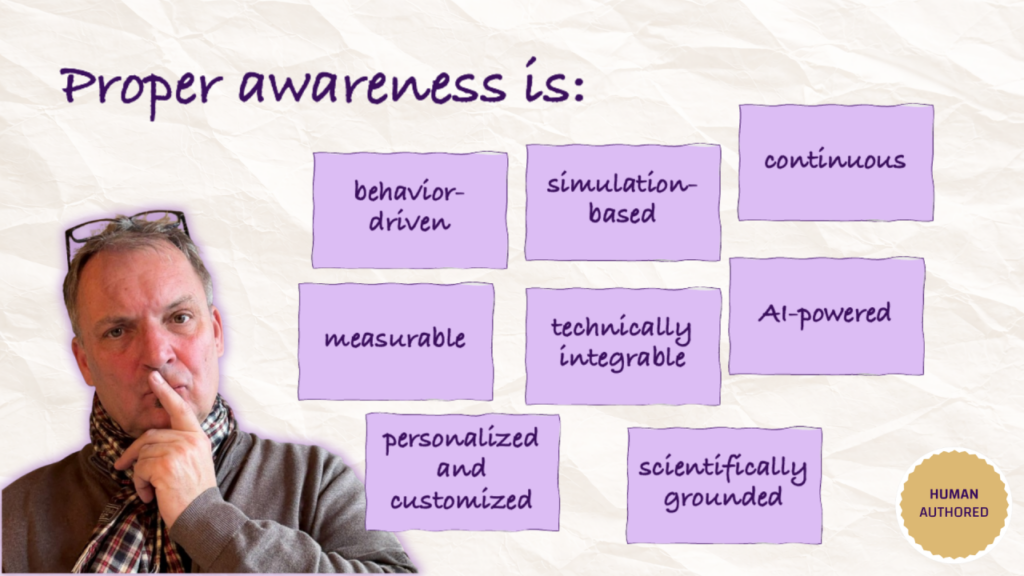
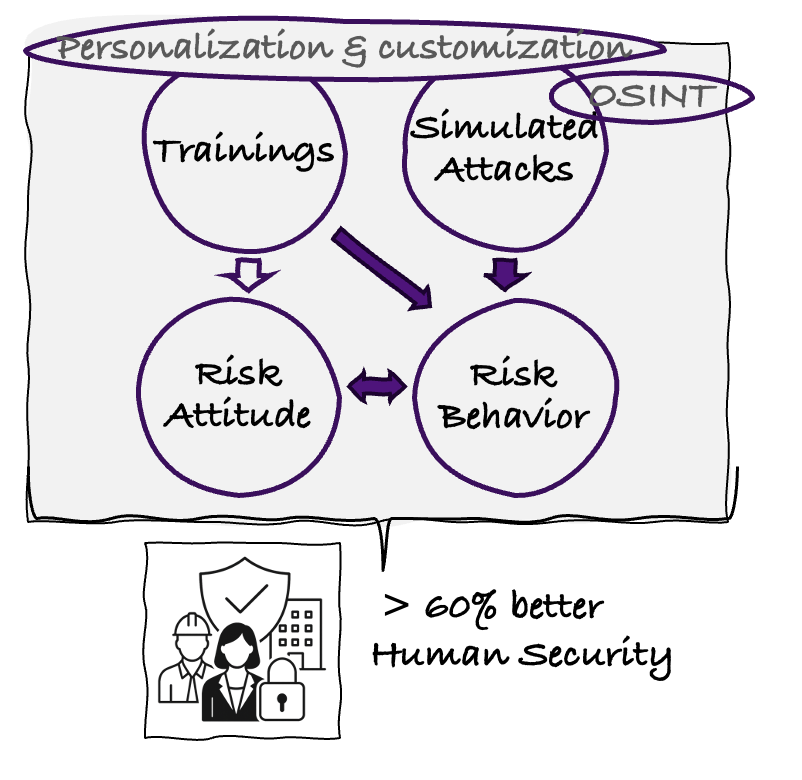
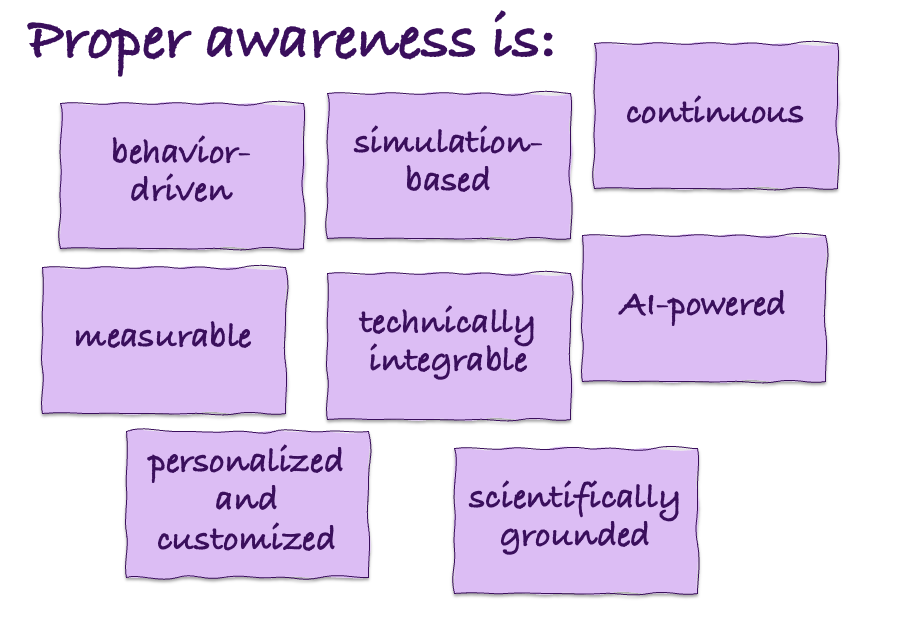
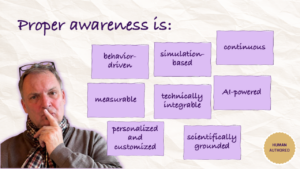
But what is proper awareness? Studies show that normative training improves attitudes, but only to a limited extent does it change actual behavior. Today, employees often know what would be right to do, but they act differently. Proper cybersecurity awareness therefore addresses:
- Achieving a healthy attitude toward risk
- An observable improvement in risk behavior